
Crispy, Flaky Scallion Pancakes With a Ginger-Soy Dipping Sauce
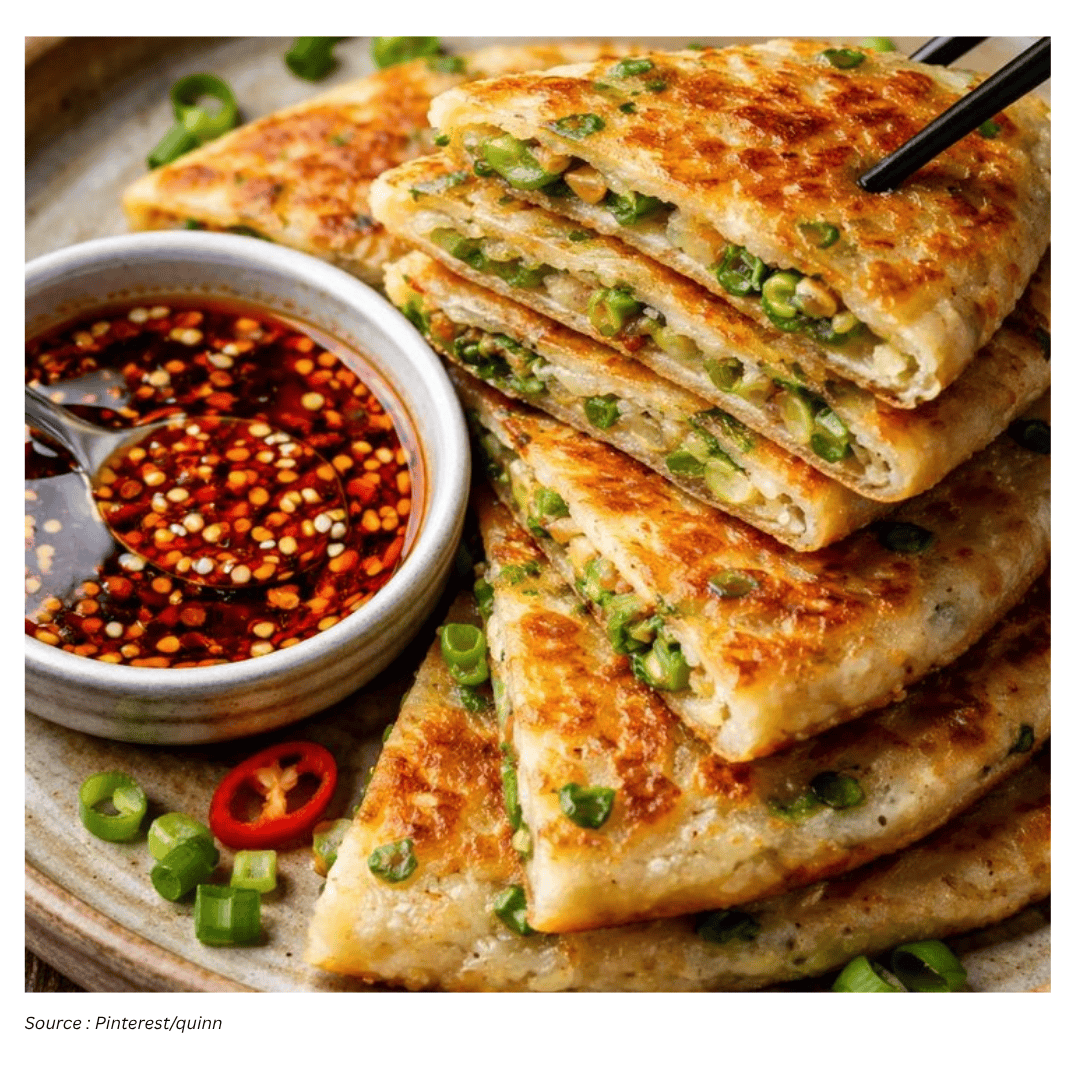
A savory pancake that eats like pastry
Scallion pancakes are one of those dishes that can disappear from a table faster than you expect. If you’ve ordered them at a Chinese restaurant, you already know the appeal: a pancake that shatters slightly at the edges, reveals soft layers inside, and carries the sharp, fresh bite of scallions throughout. They’re easy to pick up, easy to share, and just as enjoyable at room temperature as they are straight from the pan.
What surprises many home cooks is that scallion pancakes aren’t built like breakfast pancakes at all. Instead of a pourable batter, they rely on a dough that’s rolled, filled, coiled, and rolled again. That shaping creates distinct layers—more like a simple laminated pastry than a griddle cake. The good news is that the method is approachable when broken into clear steps, and the ingredient list is short enough that quality matters more than quantity.
Why hot water dough matters
The foundation of this recipe is a hot water dough. Mixing scalding hot water into flour helps inhibit gluten formation. In practical terms, that means the dough becomes softer, more pliable, and easier to roll thin without springing back. That thin rolling is crucial, because the layers you create later depend on a dough that can stretch and fold without tearing.
This is also why a rest period is built into the process. After kneading, the dough is wrapped and left to rest for at least 30 minutes. Resting gives the dough time to relax, making the rolling and shaping steps smoother and more consistent across all six pancakes.
The secret to flakiness: a sesame oil roux
Flaky scallion pancakes are often described as “layered,” and this recipe achieves that texture with a sesame oil roux. A roux is made by cooking equal amounts of flour and fat together. In many cuisines, roux is used to thicken soups and sauces, but here it plays a different role: it helps laminate the dough.
Think of the roux as a spreadable fat layer that separates sheets of dough once you roll everything up. That separation is what allows steam to form between layers during cooking, creating lift and a delicate, airy structure. The sesame oil also carries flavor through the pancake, especially if you use toasted sesame oil, which has a more intense aroma.
Ingredients to gather
Because scallion pancakes use only a handful of ingredients, it’s worth choosing good-quality staples. You’ll use all-purpose flour in both the dough and the roux, plus sea salt for seasoning. Fresh scallions provide the signature bite and fragrance. Peanut oil is used for frying, and the dipping sauce brings everything together with salty, tangy, spicy, and lightly sweet notes.
- For the dough: all-purpose flour, sea salt, scalding hot water
- For the sesame roux: sesame oil (toasted for the most intense flavor), all-purpose flour, sea salt
- For the filling: plenty of fresh scallions, sliced
- For frying: peanut oil
- For the dipping sauce: soy sauce, rice vinegar, fresh ginger root, minced Fresno or Serrano chile pepper, brown sugar
Step-by-step: dough, roux, sauce, shaping, and frying
This method is easiest when you treat it as a sequence: make the dough, make the roux while the dough rests, mix the dipping sauce, then shape and cook. The shaping steps may look long on paper, but they’re repetitive—once you form the first pancake, the remaining five go quickly.
1) Make and rest the hot water dough
- Combine 2 cups flour and ½ teaspoon salt in a stand mixer bowl.
- Using the dough hook attachment on low speed, slowly pour in the hot water until fully incorporated.
- Turn the mixer to medium speed and knead the dough until it comes together in a mass.
- Remove the dough from the bowl and briefly knead and shape into a ball.
- Wrap the dough in plastic and let it rest for at least 30 minutes.
That rest is not optional if you want easy rolling. If the dough feels tight or resistant later, a little extra rest time can help.
2) Cook a quick sesame oil roux
- While the dough rests, heat the sesame oil in a small skillet over medium heat.
- Add the remaining ½ cup flour and ½ teaspoon salt and cook and stir for 1 minute to make a roux.
- Transfer the roux to a small bowl to cool.
This is a briefly cooked, “blonde” roux. It’s designed to coat and separate layers rather than to deepen into a darker, more intensely flavored roux.
3) Mix the ginger-soy dipping sauce
- In another small bowl, combine soy sauce, rice vinegar, fresh ginger, minced Fresno or Serrano chile pepper, and brown sugar.
- Set aside.
The sauce balances several elements at once: soy sauce brings salt and depth, rice vinegar adds brightness, ginger and chile contribute heat and aroma, and brown sugar rounds the edges so the spice doesn’t dominate.
4) Divide, fill, roll, and coil the pancakes
- Unwrap and knead the dough briefly then divide it into 6 even pieces.
- Shape the dough into balls with your hands and keep them covered with plastic or a damp tea towel so that they do not dry out.
- Use a rolling pin to roll out one dough ball into a rectangle about 10 inches long and 5 inches tall.
- Spoon a tablespoon of the roux onto the dough and spread it into an even layer, leaving a small border around the edge with no filling.
- Sprinkle 2 tablespoons sliced scallions onto the surface of the roux, keeping them close to the left and bottom edge.
- Carefully roll up the dough from the bottom of the long side to form a long cylinder.
- Flatten the cylinder gently to seal and pinch closed the left end with your fingers.
- Starting with the pinched end, roll the cylinder into a spiral shape.
- Gently press down on the spiral and cover with plastic or a towel.
- Repeat for the remaining dough until all have been filled and formed.
The roll-and-coil step is where the layering happens. The roux acts as a barrier between sheets of dough, and the spiral creates multiple turns of those sheets in a compact shape.
5) Roll each spiral into a pancake
- Cut 6 parchment or waxed paper squares about 8 inches across.
- Roll each spiral into a pancake about 6 inches in diameter, laying them out on a platter with parchment or waxed paper in between.
- Line a second platter or plate with paper towels.
Using parchment between pancakes keeps the rolled rounds from sticking and makes it easier to handle them one at a time when the pan is hot.
6) Pan-fry until crisp, golden, and puffed
- Heat a cast iron or other similar non-stick skillet over medium heat and add about 2 tablespoons peanut oil to fully coat the bottom of the pan.
- Once the oil is hot, carefully lower one pancake into the pan and use chopsticks or tongs to gently rotate the pancake to evenly coat with the oil.
- Cook for 2 minutes until the first side is golden brown.
- Use chopsticks or a spatula to carefully flip the pancake.
- Cover the pan and cook for another minute. The steam will help the layers in the dough to puff.
- Uncover and continue cooking until golden, flipping the pancake again and continuing to cook until the pancake is puffed and crisp. Adjust the heat as needed so the pancakes do not burn.
- Transfer the pancake to the paper towel-lined plate.
- Repeat the process, adding about 2 tablespoons peanut oil to the pan before cooking each pancake.
- Once all the pancakes are cooked, cut them into wedges and serve them warm with the dipping sauce.
The covered minute is a small step with a big payoff. Trapping steam briefly helps the laminated layers expand, giving you a lighter interior while the outside stays crisp.
Serving ideas and hosting notes
Scallion pancakes are naturally social food. Cutting each pancake into wedges makes them easy to share, and the dipping sauce encourages a snackable, pass-around style. They also travel well and hold up at room temperature, which is part of what makes them so practical for gatherings.
If you’re putting out a spread, the recipe also suggests setting out a variety of condiments for guests to dip or top their pancakes with. Even with just the ginger-soy sauce, the pancakes offer plenty of contrast: crisp and tender, rich sesame notes and sharp scallion freshness, with tangy heat on the side.
Make-ahead and storage options
One of the most useful features of this recipe is how well it fits into an advance-prep schedule. You can do most of the work earlier—mixing the dough, making the roux, filling, rolling, coiling, and rolling the pancakes—then cook them shortly before serving.
- Freezing raw pancakes: Prepare the dough, fill and roll out the pancakes, then freeze them with layers of parchment paper in between in a ziplock bag. Thaw and cook as needed.
- Leftover cooked pancakes: Store under refrigeration, then re-crisp and reheat in a lightly oiled skillet or an air fryer.
This flexibility is especially helpful if you want the best texture at serving time. Freshly fried pancakes deliver the loudest crunch and the most pronounced layering, but reheating can bring back much of the crispness when you have extras.
Why the dipping sauce improves with time
The dipping sauce can be made in advance, and it’s actually better that way. Resting gives the chiles time to infuse the soy-vinegar base, building a more unified flavor. The sauce can be stored in an airtight jar or other glass container for up to 5 days; bring it to room temperature before serving so the flavors taste balanced and the aroma comes through.
A quick primer: roux and laminated dough, simplified
Roux is a classic technique used across many styles of cooking. It’s made from equal amounts of flour and fat cooked together, allowing the starch to absorb the fat. Often it’s used as a thickener, and it can be cooked to different stages—from a briefly cooked blonde roux to a darker roux that brings deeper flavor. In this recipe, the roux is cooked briefly and used more like a functional spread to help create layers.
The layering itself is a hallmark of laminated dough, which is built from thin sheets of dough separated by fat. When heat hits those layers, steam gets trapped between them and creates lift, resulting in a light, flaky texture. Traditional laminated pastries like croissants rely on repeated folds with cold butter, but here the sesame roux plays a similar separating role. The rolling, coiling, and second rolling are the mechanical steps that turn a simple dough into a layered pancake.
What to expect when you get it right
When these scallion pancakes are cooked properly, the surface turns golden and crisp while the interior stays tender with visible layers. You’ll taste sesame throughout, punctuated by scallion in nearly every bite. Served in wedges with the ginger-soy dipping sauce, they’re satisfying as a snack, a party appetizer, or a side that can stand on its own—portable, dip-able, and just as tempting warm as they are cool.